
Alabama ALEA Permit Practice Test 21
- Questions30
- Correct to pass24
- Passing score80%
- Minimum age15 years
-
1. Besides a chemical test, what else supports an impaired driving charge?
Show answer
Answer B: The officer's observations of the driving and the driver
Weaving, slow responses, speech and balance observed by the officer are evidence in their own right, which is why a driver can be charged on behavior alone.
-
2. Well before an intersection, an overhead sign shows a diagram of the lanes with an arrow above each one. What is its purpose?
Show answer
Answer C: To let drivers pick the correct lane in good time
Advance intersection lane control signs display the lane assignment far enough back that drivers can move over calmly instead of at the last moment.
-
3. A bicycle symbol topped by two chevrons is painted in the middle of a travel lane. What does that marking indicate?
Show answer
Answer D: Bicyclists share the lane with motor vehicles and may ride away from the curb
A shared lane marking shows drivers where bicyclists are likely to ride in a lane used by both bicycles and motor vehicles.
-
4. How long is the driver license suspension that follows a first DUI conviction in Alabama?
Show answer
Answer D: 90 days
In addition to fines and possible jail time, a first Alabama DUI conviction carries a 90 day driver license suspension.
-
5. A line of short dashes set closer together than an ordinary lane line runs beside your lane where a ramp leaves the highway. What does a dotted line of that kind convey?
Show answer
Answer A: A warning that the lane is about to change function
Dotted lines give guidance or warning about a downstream change, such as a lane that becomes an exit only lane or a lane line carried across an intersection.
-
6. The brake pedal goes to the floor and the vehicle does not slow. What should you try first?
Show answer
Answer C: Pump the pedal quickly to try to build pressure
Most vehicles have a split braking system, so rapid pumping can often build enough pressure to slow you. If it does not, use the parking brake gradually.
-
7. The road is icy and visibility is poor, but you are driving at the posted speed limit. Is this acceptable?
Show answer
Answer A: No, because you may never drive faster than is safe for the conditions
Under the basic speed rule a driver must travel at a speed that is reasonable for the actual conditions, so a legal posted speed can still be an unlawful and unsafe speed.
-
8. The engine dies at speed and the dashboard lights go out on a dark road. What should you do?
Show answer
Answer C: Hold the wheel firmly, steer over to the shoulder and use the hazard lights
Never switch the ignition to lock, because the steering can lock; steer to the shoulder and warn traffic with the hazard lights.
-
9. At which location is this sign normally installed?

Show answer
Answer D: Facing traffic that could turn into a one-way roadway or ramp against the flow
It is posted where a driver could otherwise enter a ramp or a one-way roadway from the wrong end, so it faces exactly the traffic that has to be kept out.
-
10. Why is it useful to watch the vehicle two or three places ahead of you?
Show answer
Answer C: You get an earlier warning of slowing traffic than brake lights give
Trouble travels back through a line of traffic, so seeing it start several vehicles ahead gives you a head start on braking.
-
11. A driver moves into the space you were keeping ahead of you. What should you do?
Show answer
Answer D: Ease off and rebuild the gap in front of you
Losing a following gap is common in traffic; the answer is simply to drop back and recreate it rather than drive too close.
-
12. On an unlit road, about how far ahead do high beams normally let you see?
Show answer
Answer D: About 350 to 500 feet ahead of the vehicle
High beams light roughly 350 to 500 feet of road and low beams far less, which is why night speeds have to be chosen around the beam, not the limit.
-
13. The car ahead drifts across the lane line and back again several times. What should you do?
Show answer
Answer C: Assume that the driver is distracted or impaired, and keep well back
Drifting is a classic sign of a distracted, drowsy or impaired driver, and distance is your protection from all three.
-
14. The only person offering you a ride home has been drinking. What should you do?
Show answer
Answer B: Do not get in; find another way home
A passenger in an impaired driver's vehicle shares all of the risk and can do nothing about it from the seat, so the only safe answer is another ride.
-
15. In a work zone the temporary lane lines conflict with the old lines still visible on the pavement. Which do you follow?
Show answer
Answer C: The temporary markings, which show the current traffic pattern
Temporary markings define the traffic pattern in force, and the old lines are simply the layout that no longer applies.
-
16. You are on a city street with two lanes in your direction, cars parked along the curb and driveways every few yards. Which lane is usually safer?
Show answer
Answer B: The lane farther from the curb, away from opening doors and vehicles pulling out
Most of the hazards on such a street come from the curb side, so the inside lane gives you more space and more time to react.
-
17. What is a driver being warned about here?
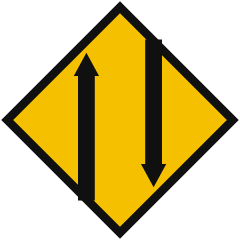
Show answer
Answer B: The pavement ahead carries vehicles traveling in the opposite direction
Beyond this point vehicles come the other way on the same pavement, which commonly happens where a one-way section or a separated stretch comes to an end.
-
18. Your headlights suddenly go out while you are driving at night. What should you do?
Show answer
Answer A: Try the dimmer switch and the headlight switch, turn on the hazard lights and pull off the road
Switching between high and low beams or cycling the light switch sometimes restores the lights. If not, use the hazard and parking lights to get off the road safely.
-
19. A yellow sign reads SOFT SHOULDER. What is it telling you?
Show answer
Answer C: The shoulder may not carry the weight of a vehicle
A soft shoulder is unpaved and can let a wheel sink, so a driver who leaves the pavement there may lose control or become stuck.
-
20. What makes up the total distance needed to bring a vehicle to a stop?
Show answer
Answer A: The distance covered while you perceive the hazard, the distance covered while you react, and the braking distance
Total stopping distance combines the ground covered while you notice the hazard, the ground covered while you move your foot to the brake, and the ground covered while the brakes slow the vehicle.
-
21. On a narrow residential street, why does parking tight against the curb matter so much?
Show answer
Answer C: Because fire trucks and ambulances need the width to get through
Cars parked even a foot out from the curb on both sides can narrow a street until a fire truck or ambulance cannot pass.
-
22. What is the what if habit of a defensive driver?
Show answer
Answer C: Thinking through what you would do if a hazard ahead of you turned bad
Rehearsing an answer before the hazard develops means you act at once instead of spending time deciding.
-
23. In most states, when are headlights required apart from times of poor visibility?
Show answer
Answer A: From about half an hour after sunset to half an hour before sunrise
Most states require lights from about half an hour after sunset until about half an hour before sunrise, and some simply say sunset to sunrise; lights are also required whenever visibility is poor.
-
24. Your car is sinking after leaving the road into deep water and two children are in the back. In what order should you act?
Show answer
Answer D: Free yourself from the belt first, then release the children, the oldest one first
You cannot help anyone while you are still belted in, and the oldest child released first needs the least help getting out.
-
25. How does a NO OUTLET sign differ from a DEAD END sign?
Show answer
Answer B: It warns that a whole group of streets has no way out
No Outlet is posted where the road leads into a network of streets from which there is no through route, while Dead End refers to the single street itself.
-
26. How does a lap and shoulder belt protect you in a crash?
Show answer
Answer B: It holds you to the seat and spreads the force over the strong bones
The belt keeps you with the vehicle as it slows and puts the load on the hips and the chest rather than on soft tissue.
-
27. Another driver is behaving aggressively toward you. What should you do?
Show answer
Answer D: Avoid eye contact, give them room to go on their way and do not respond to provocation
Responding to an aggressive driver escalates the conflict, while creating distance and refusing to engage takes you out of the situation. Report serious threats once you can do so safely.
-
28. You are about to make a three-point turn on a narrow two-way street. What is the first step?
Show answer
Answer B: Pull close to the right edge, signal left and check traffic both ways
A three-point turn starts from a stop at the right edge with a left signal, and you only move once you have checked that both directions are clear.
-
29. Why should you avoid parking over tall dry grass or a pile of dead leaves?
Show answer
Answer B: Because the hot exhaust can set the dry material on fire
The exhaust system stays hot for a long time after a drive and can ignite dry vegetation underneath the vehicle.
-
30. Which statement about standard drinks is correct?
Show answer
Answer C: A standard serving of beer, of table wine and of distilled spirits each contain about the same amount of pure alcohol
Roughly 12 ounces of regular beer, 5 ounces of table wine and 1.5 ounces of 80 proof spirits each contain about the same amount of pure alcohol, so the type of drink does not change the effect.