
Alabama ALEA Permit Practice Test 8
- Questions30
- Correct to pass24
- Passing score80%
- Minimum age15 years
-
1. You are at a red light where right turns on red are allowed, you cannot see clearly, and the driver behind sounds the horn. What should you do?
Show answer
Answer C: Stay stopped until you can see that the turn is safe
Turning right on red is permitted, never required, so you wait until you can see that the way is clear no matter what the driver behind does.
-
2. What does the C restriction mean on an Alabama driver license?
Show answer
Answer B: Daylight only
In the Alabama restriction table C stands for daylight only, while A covers corrective lenses and G covers automatic transmission.
-
3. The sign over the leftmost lane reads LEFT LANE MUST TURN LEFT. You are in that lane and want to go straight. What should you do?
Show answer
Answer C: Move out of the lane before the intersection if it is safe
A mandatory movement lane control sign makes the turn compulsory for that lane, so a driver who wants another movement must change lanes in advance.
-
4. A blue motorist service sign showing a fuel symbol and an arrow means that
Show answer
Answer D: fuel is available in the direction shown, and the sign imposes no obligation
Service signs are informational: they tell the driver what is available and in which direction, but they create no requirement.
-
5. The brake warning light stays on even though the parking brake is fully released. What does it indicate?
Show answer
Answer B: A possible brake system problem, so have the brakes checked promptly
The brake warning light also signals low brake fluid or a failure in one part of the hydraulic system. Do not ignore it, because braking may be reduced.
-
6. Does using a hands free device remove the risk of distraction?
Show answer
Answer A: No, the conversation still takes attention away from driving
Hands free equipment removes the manual part of the distraction but not the mental part, and a driver deep in conversation can look straight at a hazard without registering it.
-
7. How far before a turn does the Alabama manual say a driver should signal?
Show answer
Answer A: At least 100 feet
The Alabama manual instructs drivers to signal at least 100 feet before making the turn and to hold the signal until the turn begins.
-
8. A city transit bus ahead of you has stopped at the curb with its passenger door open. What does the law require of you?
Show answer
Answer D: Nothing special, but pass slowly and watch for people
The mandatory stop applies to a school bus showing red flashing lights, not to a transit bus, though a careful driver still slows for crossing passengers.
-
9. How far from a stopped school bus with its stop arm out must an Alabama driver stop?
Show answer
Answer B: At least 20 feet
The Alabama manual instructs drivers coming from either direction to stop at least 20 feet from a school bus displaying its stop signals.
-
10. Why is passing on a curve prohibited even when the traffic seems light?
Show answer
Answer C: You cannot see far enough around it to know the lane is clear
A pass is only as safe as the distance you can see, and a curve hides the very lane the maneuver uses.
-
11. What speed limit does Alabama apply in school zones?
Show answer
Answer C: 15 mph
Alabama uses a 15 mph school zone limit, the lowest figure in the state speed limit schedule.
-
12. In heavy stop-and-go traffic, why does using both lanes right up to a merge point help?
Show answer
Answer D: It stores the queue in two lanes, so the backup is shorter
Filling both lanes halves the length of the queue and keeps it away from the traffic upstream, which is why alternating at the merge point works better when traffic is slow.
-
13. What is the only reliable remedy for a driver who is sleepy?
Show answer
Answer A: Sleep
Caffeine, fresh air and noise may make you feel alert for a few minutes, but they do not remove the need for sleep. Stop somewhere safe and rest.
-
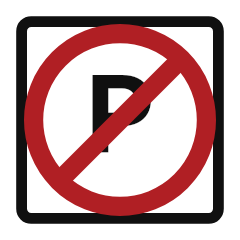
14. A driver leaves the vehicle at the curb where this sign is posted and walks away for two minutes. Is that allowed?
Show answer
Answer B: No, leaving the vehicle unattended there is prohibited whatever the length of the absence
Walking away leaves the vehicle parked, and the prohibition holds regardless of how long the driver is gone or whether the engine is left running.
-
15. At a railroad crossing with no gates and no flashing lights, the crossbuck is normally combined with which sign?
Show answer
Answer C: A yield sign, or a stop sign where an engineering study calls for one
At a passive crossing the crossbuck forms an assembly with a yield sign, or with a stop sign when an engineering study or engineering judgment supports it, so the driver knows who must give way to the train.
-
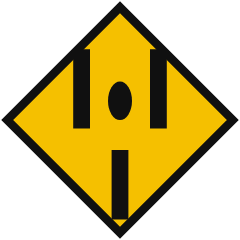
16. What should a driver do first after passing this sign?
Show answer
Answer A: Move into the right-hand lane and stay there
Traffic returns to two-way operation, so the driver keeps to the right of the centerline and stops treating the left side as available.
-
17. A driver behind you on a two-lane road clearly wants to pass. Why should you not wave that driver past?
Show answer
Answer B: You cannot see the whole road ahead for them and they may rely on your signal
Waving another driver out invites them to trust your judgment of a road you cannot see well enough, and the decision to pass belongs to the driver making it.
-
18. You are on a country road with no sidewalk and two people are walking toward you on your side of the shoulder. What should you do?
Show answer
Answer C: Slow down and move over to give them room
Where there is no sidewalk, people are expected to walk on the shoulder facing traffic, and drivers must slow and give them space.
-
19. You have strapped luggage to the roof rack for a long trip. What should you expect?
Show answer
Answer D: A higher center of gravity, so take the curves and lane changes gently
Weight on the roof raises the center of gravity and makes the vehicle lean and respond more slowly to steering.
-
20. A crash happens directly in front of you and vehicles are blocking both lanes. What should you do?
Show answer
Answer B: Stop at a safe distance, put on the hazards and warn the traffic behind
The greatest danger after a crash is a second collision, so stop short of it and make sure the traffic behind you can see the problem.
-
21. A broken white line separates your lane from the lane beside it. What does it indicate?
Show answer
Answer C: Both lanes carry traffic in the same direction and lane changes are permitted
White lines separate lanes of traffic moving in the same direction, and a broken white line means changing lanes across it is permitted when it is safe.
-
22. You carry reflective warning triangles in your car. How should they be used after a breakdown?
Show answer
Answer B: Set out behind the vehicle, far enough back to warn traffic before it arrives
A warning device works only if drivers see it in time to react, so it is placed well back along the road they are traveling.
-
23. A train has just passed a crossing that carries more than one set of tracks. What should you do?
Show answer
Answer B: Wait until the warning devices stop and you can see clearly along every track
A passing train can hide a second one coming on another track, so wait for the signals to clear and check each track before moving.
-
24. A speed limit sign carries a second panel reading TRUCKS 55. What does that panel do?
Show answer
Answer B: It sets a lower legal limit for trucks
A truck speed limit panel is regulatory, so trucks are bound by the lower figure while other traffic keeps to the main limit.
-
25. A motorcycle ahead of you has its turn signal blinking but continues straight through several intersections. What is the likely explanation?
Show answer
Answer D: Motorcycle signals often do not cancel themselves after a turn
Many motorcycle turn signals are not self-cancelling, so a rider may leave one on by mistake. Wait until the rider actually starts to turn before you act on the signal.
-
26. You are turning left out of a driveway onto a busy two-way street. What must you do?
Show answer
Answer D: Wait for a gap in both directions before you start to move
The turn crosses one direction of traffic and joins the other, so you need a gap in both before leaving the driveway rather than stopping across a lane.
-
27. At many crossings the walk indication appears only after a button is pressed. What happens if a pedestrian does not press it?
Show answer
Answer B: The signal may cycle without showing a walk indication
An actuated pedestrian phase is called in by the pushbutton, so without it the controller may serve the vehicle movements alone.
-
28. A driver's blood alcohol concentration is below the legal limit, but the driver is visibly impaired. Can the driver be arrested?
Show answer
Answer C: Yes, driving while impaired by alcohol is an offense at any concentration
The per se figure, 0.08 percent in most states and 0.05 percent in Utah, is the level at which impairment is presumed. Impairment shown by driving behavior and field tests is enough on its own, because alcohol affects skills well before that number.
-
29. You have stopped on the shoulder of a busy freeway with a flat tire that you cannot change safely. Where should you and your passengers wait?
Show answer
Answer A: Well away from the traffic side, behind a barrier or up the bank if there is one
People struck on the shoulder are a common cause of roadside deaths, so wait away from the traffic side and behind any barrier.
-
30. A sign at the intersection prohibits U-turns, but the opening looks wide and clear. What may you do?
Show answer
Answer B: Obey the sign and turn around somewhere else
A prohibition applies whatever the traffic looks like at that moment, usually because of sight distance or conflicts you cannot see from the lane.