
Alabama ALEA Motorcycle Practice Test 13
- Questions30
- Correct to pass24
- Passing score80%
- Minimum age16 years
-
1. The rear tire loses air suddenly while you are riding. Which symptom should you expect and how should you respond?
Show answer
Answer D: The rear sways or feels heavy, so ease off and slow with the front brake
A rear flat makes the back of the motorcycle wallow or sway, so hold your line, close the throttle gently and slow mainly with the brake on the wheel that still has air.
-
2. You are turning right off a street into a parking lot driveway that crosses a bike lane and a sidewalk. Who has the right of way?
Show answer
Answer D: Pedestrians on the sidewalk and riders in the bike lane
Turning into a driveway means crossing the paths of people who were already traveling straight, so you give way to both the bike lane and the sidewalk.
-
3. What is the danger of releasing the brake too early when moving off uphill?
Show answer
Answer C: The motorcycle rolls backward before the clutch has taken hold
On a grade the brake has to stay on until the engine is actually pulling, otherwise the machine runs back into whatever is behind it.
-
4. What is the main danger of grabbing the front brake lever abruptly?
Show answer
Answer D: The front wheel can lock, and a locked wheel cannot steer or balance
The front brake must be squeezed progressively so that weight transfers onto the front tire before full braking force is asked of it.
-
5. What does a NARROW BRIDGE warning sign tell a driver?
Show answer
Answer A: The bridge is tighter than the road leading up to it
A narrow bridge still carries both directions, but with much less clearance than the approaches, so drivers should slow and hold their lane position carefully.
-
6. A yellow diamond shows a horse with a rider. Besides slowing down, what else should a driver do?
Show answer
Answer C: Avoid using the horn or revving the engine
The equestrian crossing sign warns of horses on or across the road, and a sudden noise can startle an animal into the traffic lane.
-
7. On a divided highway you see a median opening marked for authorized vehicles only. May you use it to turn around?
Show answer
Answer D: No, those openings are for emergency and maintenance vehicles
Official crossovers are reserved for emergency and highway maintenance use; turning there puts a slow vehicle across high-speed traffic.
-
8. On a first Alabama DUI conviction, which finding about the driver makes a one year ignition interlock mandatory?
Show answer
Answer A: A blood alcohol content of 0.15 percent or more
Alabama makes the interlock mandatory for one year on a first conviction when the driver measured 0.15 percent or more, refused the test, injured someone, or carried a young child.
-
9. The car ahead of you slows down for no reason that you can see. Should you pull out and pass?
Show answer
Answer B: No, find out why it is slowing before you commit to the other lane
A driver usually slows for something, such as a turn, a hazard or a pedestrian, and that something is often exactly where your pass would take you.
-
10. You are approaching an intersection in a line of traffic. What can you do to be more visible to a driver waiting to pull out?
Show answer
Answer D: Move to a lane position where you are not hidden behind the vehicle ahead
A motorcycle tucked directly behind a larger vehicle is invisible to a waiting driver until the moment it appears, so the rider moves to where the headlight can be seen.
-
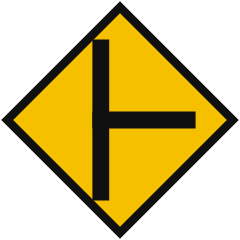
11. Approaching the point this sign refers to, which hazard is most likely?
Show answer
Answer A: A vehicle pulling out from the entering road into the driver's path
The main risk is a driver on the entering road who misjudges the gap and pulls out, so covering the brake and being ready to slow is the sensible response.
-
12. You need to reverse direction on a busy street. Which choice is usually safest?
Show answer
Answer D: Driving around the block and using the intersections instead
Going around the block uses normal turns at controlled intersections instead of stopping across live traffic lanes.
-
13. Which warning sign keeps its yellow background even when it is used inside a work zone?
Show answer
Answer D: The grade crossing advance warning sign
The round grade crossing advance warning sign keeps its black legend on yellow inside temporary traffic control zones because the railroad hazard it describes is not temporary.
-
14. Is dictating a message by voice a safe alternative to typing one?
Show answer
Answer C: No, it still takes attention from driving
Composing and checking a spoken message loads the mind and usually pulls the eyes to the screen anyway, so research finds it no safer than other phone use.
-
15. How can a first time Alabama hands free offender avoid being found guilty?
Show answer
Answer D: By producing a hands free device or proof of buying one in court
An Alabama driver appearing on a first hands free charge who produces a device or proof of purchase, and affirms the privilege has not been used before, is not guilty of the offense.
-
16. Studies of damaged helmets show that the most frequently struck area is which part?
Show answer
Answer C: The chin and jaw area, which an open face helmet leaves uncovered
The chin and face area takes a large share of helmet impacts, which is the main safety argument for a full face helmet over an open face one.
-
17. May you stop briefly across the sloped ramp that joins the sidewalk to the street at a corner?
Show answer
Answer B: No, that ramp must stay clear for people using wheelchairs
A curb ramp is the only way many people can get from the sidewalk to the crosswalk, so blocking it even briefly is prohibited.
-
18. A bicyclist is riding in the middle of a narrow travel lane ahead of you. What is the correct response?
Show answer
Answer D: Slow down and wait until you can pass with wide clearance, changing lanes if needed
A bicyclist has the same right to use the lane as a driver, and a narrow lane may not leave safe passing room, so wait for a gap that lets you move over and pass with a wide margin.
-
19. You are approaching a driveway where a car waits to pull out and the driver is looking your way. What should you assume?
Show answer
Answer D: The driver may not have seen you, so cover the brakes and be ready to slow
Looking in your direction is not proof that a driver has registered a motorcycle, so cover the brakes and be ready to slow until the car is clearly staying put.
-
20. In most states, how far before a turn must your signal already be on in city traffic?
Show answer
Answer B: At least 100 feet, roughly the length of six or seven cars
Most states require the signal for at least 100 feet before a turn in city driving, which gives drivers behind you time to react before you slow; several require more at higher speeds.
-
21. How does a wet road change the distance you need to stop?
Show answer
Answer C: It lengthens it, so you need a much bigger gap ahead
Water between the tire and the road cuts grip, so braking distance grows and the gap that works on dry pavement is no longer enough.
-
22. The front brake lever feels soft and travels almost to the handgrip. What should the rider do?
Show answer
Answer D: Leave the motorcycle where it is until the brake system has been inspected
A spongy lever usually means air or fluid loss in the system, and a brake in that condition can fail completely under hard use.
-
23. What does the choke, or enrichener, do on a motorcycle that has one?
Show answer
Answer B: It gives the engine a richer fuel mixture so a cold engine will start
A cold engine needs more fuel in proportion to air, and the choke supplies that richer mixture until the engine warms up.
-
24. While you swerve around an obstacle, what should the rest of your body be doing?
Show answer
Answer C: Staying upright with the knees against the tank while the motorcycle leans
A swerve happens through the handlebars, and a body that stays still and anchored to the tank lets the motorcycle move quickly beneath the rider.
-
25. How should a motorcycle helmet fit?
Show answer
Answer A: Snugly all the way around, without shifting or lifting off the head
A snug helmet stays in place during a crash, while one that moves or lifts can come off at the moment it is needed most.
-
26. The light ahead is green but traffic beyond the intersection is backed up. What should you do?
Show answer
Answer B: Wait behind the intersection until there is room to clear it completely
You may not enter an intersection unless you can get completely through it, because stopping inside blocks cross traffic when the signal changes.
-
27. What should the operator do while a passenger climbs on board?
Show answer
Answer D: Sit on the machine with both feet planted and the front brake held on
The added weight arrives suddenly and off center, so the operator braces the motorcycle with both feet down and the front brake applied to keep it still.
-
28. A helmet falls from the seat onto a hard floor but shows no cracks. What should the owner do?
Show answer
Answer C: Replace it or have it checked, because the liner can be crushed inside
The foam liner can be compressed with no outside sign, and crushed foam will not absorb a second impact, so a helmet that has taken a hard knock should be replaced.
-
29. You are in the right-hand lane of a multilane street and that lane becomes a right-turn-only lane ahead, but you want to go straight. What should you do?
Show answer
Answer B: Change into a through lane before you reach the markings for the turn lane
A lane-use arrow is a regulatory marking, so a driver who wants to continue straight has to leave that lane before it becomes a mandatory turn lane.
-
30. A motorcycle ahead of you is weaving slightly as it crosses a stretch of grooved pavement. What should you do?
Show answer
Answer D: Give the rider extra room until the surface improves
Grooves, metal plates and loose material affect a motorcycle far more than a car, so back off and let the rider deal with the surface.