
Alabama ALEA Motorcycle Practice Test 16
- Questions30
- Correct to pass24
- Passing score80%
- Minimum age16 years
-
1. A driver reaching a stop sign is required to do what?
Show answer
Answer D: Come to a complete stop and then proceed only when it is safe
A stop sign requires a full stop before the stop line, crosswalk or intersection, after which the driver may go on once the way is clear.
-
2. What identifies a helmet as certified to the federal motorcycle helmet standard?
Show answer
Answer C: A label showing DOT and the words FMVSS No. 218 CERTIFIED
Certified helmets carry a label with the DOT symbol and the wording FMVSS No. 218 CERTIFIED, together with the maker's name and the model.
-
3. A high truck ahead of you hides the traffic signal as you approach the intersection. What should you do?
Show answer
Answer A: Drop back so you can see the signal and the truck's brake lights
Extra following distance restores your view of the signal, so you are reacting to the light yourself rather than copying the truck driver.
-
4. During the first 12 months after Alabama's hands free statute came into force in June 2023, what could an officer issue for a violation?
Show answer
Answer D: Only a written warning, with no points recorded
For 12 months from 14 June 2023 an Alabama officer could issue only a written warning for a hands free violation, and no points were recorded.
-
5. You are traveling beside a solid white lane line. What does it tell you?
Show answer
Answer B: Crossing it is discouraged or prohibited, so stay in your lane
A solid white line separates lanes going the same direction where lane changing is discouraged or prohibited, such as where a through lane meets a mandatory turn lane.
-
6. A car in the lane to your left keeps drifting toward the line between you. Which portion of your lane should you move to?
Show answer
Answer A: The right portion
Moving to the far side of your lane buys distance and time if that driver keeps coming, and it may also make the motorcycle visible to a driver who had not noticed it.
-
7. You have stopped on an uphill grade close behind a large truck at a traffic signal. What is the risk?
Show answer
Answer B: The truck may roll back into you when it starts to move
Heavy vehicles can roll backward a short distance when the driver moves from the brake to the accelerator on a hill. Leave extra room when stopped behind a truck on a grade.
-
8. A rider adjusts the mirrors and finds each one mostly filled with a view of an elbow. What should be done?
Show answer
Answer D: Readjust them outward so that more of the lane behind becomes visible
Mirrors are useful only for the road behind, and half a mirror filled with the rider is half of an already limited view thrown away.
-
9. On a rural road, the driver of a slow farm tractor ahead of you signals a left turn even though there is no road or driveway in sight. What should you do?
Show answer
Answer B: Stay behind the tractor, because it may be turning into a field entrance
Farm equipment often turns into fields through gaps you cannot see, and it may swing wide to do so. Passing a vehicle that is signaling a left turn is a common cause of crashes.
-
10. When are you expected to switch from high beams to low beams?
Show answer
Answer D: When a vehicle approaches from ahead or you come up behind another vehicle
High beams blind other drivers, both those coming toward you and those you follow through their mirrors. Dim them whenever another vehicle is within range.
-
11. On an unlit road, about how far ahead do high beams normally let you see?
Show answer
Answer D: About 350 to 500 feet ahead of the vehicle
High beams light roughly 350 to 500 feet of road and low beams far less, which is why night speeds have to be chosen around the beam, not the limit.
-
12. You have a steady green ball to turn left, and the oncoming traffic gets a green left arrow. What does that mean for you?
Show answer
Answer C: Oncoming vehicles will turn across your path, so you must wait
A green ball is permissive, so when the oncoming side receives a protected arrow those vehicles have priority and you must yield until they clear.
-
13. In Alabama, if you cannot safely change lanes for a stopped emergency vehicle, how much must you reduce your speed?
Show answer
Answer B: To at least 15 mph below the posted speed limit
When moving over is unsafe, the Alabama Move Over Act requires the driver to slow to a speed at least 15 mph under the posted limit.
-
14. An overhead lane-use control signal shows a steady red X above your lane. What does it mean?
Show answer
Answer B: You may not use that lane and must move out of it
A steady red X means the lane below it is closed to you, while a steady yellow X is the warning to prepare to vacate the lane and a downward green arrow means the lane is open.
-
15. You are driving slower than the general flow on a multilane highway. Which lane should you use?
Show answer
Answer D: The right lane, keeping the left lanes free for faster traffic and passing
Slower traffic must keep right so that faster vehicles and overtaking traffic can use the left lanes without weaving between lanes.
-
16. How much space should you hold behind the rider who is directly ahead of you in your own portion of the lane?
Show answer
Answer D: At least two seconds
Riders sharing the same track keep a following distance of at least two seconds so they have the time and the room to react to a hazard.
-
17. A driver stopped on suspicion of impaired driving refuses to take a chemical test. What happens?
Show answer
Answer D: A license penalty follows for the refusal itself
Under implied consent, holding a license means agreeing to testing, so a refusal brings its own suspension separately from anything the court decides.
-
18. You are riding at 30 miles an hour and need to move quickly to the left. What do your hands do?
Show answer
Answer D: Press forward on the left handgrip
Above a walking pace a motorcycle turns by leaning, and pressing forward on the grip on the side you want to go is what starts the lean.
-
19. Why is the center portion of the lane a useful default on an open road?
Show answer
Answer B: It keeps a space cushion on both sides and discourages lane sharing
From the middle of the lane the rider has room to move either way, and no driver sees an obvious gap alongside to squeeze into.
-
20. What should a rider check about the size of a motorcycle before riding it?
Show answer
Answer C: That both feet reach the ground and the controls are within reach
A motorcycle that fits lets the rider put both feet down at a stop and work every control without stretching, and a machine that is too tall or too heavy is hard to hold up in slow traffic.
-
21. A notification appears on your smart watch while you are driving. What should you do?
Show answer
Answer B: Treat it as you would a phone and leave it
A watch screen demands the same eyes and the same attention as a phone, and a wrist is no safer a place to read a message than a dashboard.
-
22. A wide solid white line separates the through lanes from an exit lane. What does it tell drivers?
Show answer
Answer B: The choice of lane should already have been made
A channelizing line marks where the paths separate and crossing it is discouraged or prohibited, so the lane change has to happen upstream.
-
23. Which surfaces usually offer less grip than the pavement around them when wet?
Show answer
Answer B: Painted markings, metal plates and bridge decks
Paint, steel and bridge decks all shed grip when wet or cold, so brake before you reach them rather than on top of them.
-
24. The low sun is directly ahead and glare makes it hard to see. What should you do?
Show answer
Answer C: Slow down, use the sun visor or sunglasses, and increase following distance
Sun glare can hide pedestrians, brake lights and signals. Reducing speed and adding space gives you time to react to what you cannot yet see.
-
25. You are riding in the middle of a tight cluster of cars on a multilane road. What is the best way to improve your safety?
Show answer
Answer C: Ride slightly faster or slower to open space and get clear of the cluster
A rider hemmed in on all sides has nowhere to go, so change your speed a little to open an escape path and leave the crowd.
-
26. A mixed drink is made with two shots of spirits. How much alcohol is that?
Show answer
Answer C: About two standard drinks
A standard drink is a fixed amount of pure alcohol, so a glass poured with two measures counts as two drinks however it is served.
-
27. What is a driver being warned about here?
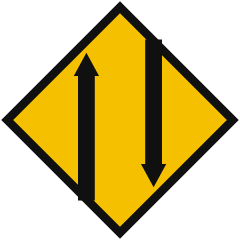
Show answer
Answer B: The pavement ahead carries vehicles traveling in the opposite direction
Beyond this point vehicles come the other way on the same pavement, which commonly happens where a one-way section or a separated stretch comes to an end.
-
28. Small green signs with white numerals posted at regular intervals along a highway are used to
Show answer
Answer B: show distance along the route and give a reference point for reporting a location
Reference location signs, commonly called mileposts, carry white numerals on green and let a driver describe exactly where a breakdown or crash has occurred.
-
29. A driver is following you far too closely. What is the best response?
Show answer
Answer D: Increase your own following distance and let the driver pass when it is safe
More room ahead of you means you can slow gradually instead of braking hard, which reduces the chance of being struck from behind, and letting the driver by removes the problem entirely.
-
30. Why do safety agencies put head protection first among riding gear?
Show answer
Answer A: Because head injuries are the leading cause of death in motorcycle crashes
Head injury is the most common cause of death in motorcycle crashes, which is why a certified helmet is the single most important piece of gear.