
Alabama ALEA Motorcycle Practice Test 42
- Questions30
- Correct to pass24
- Passing score80%
- Minimum age16 years
-
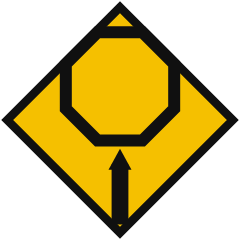
1. On a wet road, how should a driver adjust after passing this sign?
Show answer
Answer B: Start braking earlier, because a slippery surface lengthens the stopping distance
A wet surface lengthens stopping distance, so the extra warning distance should be spent braking gently and early instead of late and hard.
-
2. You are riding along a street lined with parked cars. What is the safest approach?
Show answer
Answer D: Move away from the parked cars, slow down, and watch for doors and people
Doors open, drivers pull out and pedestrians step between vehicles, so extra space and a lower speed give the rider time to see and react.
-
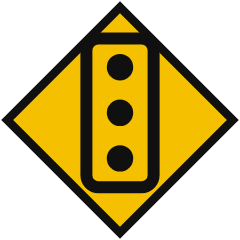
3. A driver passes this sign and the signal beyond it is already showing green. What is the safest response?
Show answer
Answer C: Ease off the accelerator and be ready to stop, because an indication that has been showing for a while is about to change
A signal that has been displaying the same indication for some time is close to changing, so arriving at a controlled speed with the brake covered is safer than accelerating to beat it.
-
4. You come up behind a group of cyclists riding two abreast on a narrow rural road. What should you do?
Show answer
Answer A: Wait for a clear stretch and pass them as one group
Passing a group as a single unit when the way ahead is clear is safer than several rushed passes, and cutting through the group leaves nobody any escape room.
-
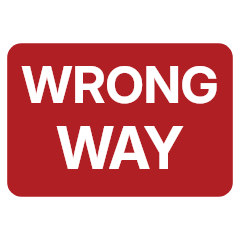
5. At a freeway exit ramp, this sign normally backs up which other regulatory sign posted nearer to the ramp terminal?
Show answer
Answer D: The sign that forbids entering that roadway at all
The two work as a pair at ramp terminals: one keeps drivers from turning in, and this one sits farther along to catch a driver who has already entered.
-
6. What is the PRIME position on a fuel supply valve used for?
Show answer
Answer D: To let fuel flow into the carburetor after the machine has stood unused
PRIME bypasses the normal vacuum control and lets fuel refill an empty carburetor, which helps a machine start after sitting for a long time.
-
7. What is the correct order of actions when passing a vehicle on a two lane road?
Show answer
Answer D: Signal, check the mirrors and blind spot, pass in the left lane, signal and return
The rider signals and checks behind before moving out, completes the pass in the passing lane, then signals and checks again before returning.
-
8. Many signs use a symbol instead of words. The main advantage is that a symbol
Show answer
Answer C: can be read from farther away and by more people
A symbol is recognized at greater distance than a line of text and does not depend on the reader knowing English.
-
9. When should a helmet be replaced?
Show answer
Answer B: After a crash, or if the shell is cracked or the straps are frayed
The energy absorbing liner is designed to crush once, so a helmet that has taken an impact or shows damage no longer offers full protection.
-
10. You are riding in the right hand lane of a freeway and vehicles ahead are merging on from an entrance ramp. What is the best response?
Show answer
Answer C: Change lanes if you safely can, or adjust speed to open a gap for them
Merging drivers are looking over a shoulder for a gap and easily miss a motorcycle, so the rider makes room rather than waiting to be seen.
-
11. Which part of the body operates the gearshift lever?
Show answer
Answer B: The left foot
The gearshift lever sits ahead of the left footrest and is moved up or down with the left foot.
-
12. The street you are turning right onto has a bike lane along its right edge. Where should your vehicle end up?
Show answer
Answer B: In the first traffic lane to the left of the bike lane
A bike lane is not a travel lane for motor vehicles, so the nearest lane you may finish a right turn in is the first general traffic lane beside it.
-
13. What is wrong with riding in sneakers or sandals?
Show answer
Answer D: They come off, expose the foot and give no protection in a fall
Light footwear tears away or comes off in a crash and offers no abrasion or crush protection for the foot and ankle.
-
14. You are traveling beside a tractor-trailer and cannot see the truck driver's face in any of the truck's mirrors. What does that tell you?
Show answer
Answer A: The truck driver probably cannot see your vehicle
Large trucks have deep blind spots on all four sides, so if the driver's face is not visible in a mirror the driver has no view of you. Move ahead or drop back until you are out of that area.
-
15. A broken white line separates your lane from the lane on your right. What does it permit?
Show answer
Answer C: Changing lanes when it is safe to do so
A normal broken white line marks a boundary between lanes traveling the same way that road users may cross when it is safe.
-
16. You are approaching the crest of a hill and cannot see the road beyond it. What should you do?
Show answer
Answer C: Slow down and keep well to the right
Beyond a blind crest there may be a stopped vehicle, a cyclist or an oncoming driver crossing the center line, so reduce speed and hold your own side.
-
17. A highway lane is marked with a large white diamond and signed as a high-occupancy vehicle lane. Who may use it?
Show answer
Answer B: Only vehicles carrying at least the number of occupants shown on the sign, during the posted hours
The diamond marking identifies a preferential lane whose occupancy requirement and hours of operation are stated on the accompanying signs.
-
18. Traffic is backed up beyond a railroad crossing. When may you start across the tracks?
Show answer
Answer B: Only when there is room for your whole vehicle on the far side
Never enter a crossing you cannot clear; a vehicle stopped on the tracks in a queue has nowhere to go if the signals start.
-
19. Why is a rider advised to keep the wrist flat and low on the throttle grip?
Show answer
Answer A: It makes it harder to roll on too much throttle by accident
A flat wrist limits how far the grip can rotate in one motion, so a bump or a startled reaction is less likely to open the throttle suddenly.
-
20. What is the basic rule for entering a roundabout?
Show answer
Answer B: Traffic already circulating goes first, and you wait for a gap
Entering traffic yields to vehicles already going around the circle, which is what keeps a roundabout moving instead of locking up.
-
21. Some crosswalks are marked with two transverse lines and others with a row of wide bars laid along the direction of travel. Why is the second pattern used?
Show answer
Answer B: It is far easier for an approaching driver to see
Longitudinal bar patterns are used where extra visibility is wanted, such as an uncontrolled crossing or one near a school, because they show up much better from a car.
-
22. Where is a U-turn most clearly unsafe and generally prohibited?
Show answer
Answer D: On a curve or near a hill crest, where other drivers cannot see you
U-turns are barred where approaching drivers cannot see you in time, such as on a curve or near the top of a hill.
-
23. You are approaching a blind right hand curve. Which starting lane position gives the best view through it?
Show answer
Answer C: The left portion of the lane, toward the outside of the curve
Starting at the outside of a curve opens up the line of sight through it, and the rider then moves toward the inside as the exit comes into view.
-
24. In a work zone a flagger is directing traffic in a way that conflicts with the posted signs. Whom do you follow?
Show answer
Answer B: The flagger's directions
A flagger controls traffic through a work area that changes from day to day, and those instructions take precedence over the fixed signs and markings in that zone.
-
25. How long must an ignition interlock stay fitted after a second Alabama DUI conviction?
Show answer
Answer C: Two years
A second Alabama DUI conviction carries a two year ignition interlock requirement, which begins after 45 days of the suspension have been served.
-
26. The car ahead drifts across the lane line and back again several times. What should you do?
Show answer
Answer C: Assume that the driver is distracted or impaired, and keep well back
Drifting is a classic sign of a distracted, drowsy or impaired driver, and distance is your protection from all three.
-
27. You are leaving a freeway by an exit ramp. Where should you slow down?
Show answer
Answer D: On the ramp itself, after you have left the through lane
Braking in the through lane surprises the traffic behind, so the rider signals, moves onto the ramp and does the slowing in the space provided for it.
-
28. About how far behind a tractor-trailer does the driver's rear blind spot reach?
Show answer
Answer C: Around 30 feet
The area behind a large truck is hidden for roughly 30 feet, so a driver tucked in there cannot be seen at all.
-
29. You have stopped at a stop sign, but a parked truck blocks your view along the cross street. What should you do?
Show answer
Answer A: Creep forward slowly and stop again where you can see
When something blocks the view, a second stop closer to the intersection is the only safe way to see, and it must come before your vehicle enters the traffic lane.
-
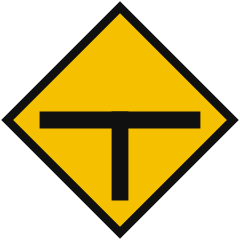
30. What must a driver be prepared to do at the point this sign refers to?
Show answer
Answer D: Turn left or right, because the road being traveled ends there
The road ends at another roadway, so the driver must slow, give way to traffic on the through road and turn in one direction or the other.